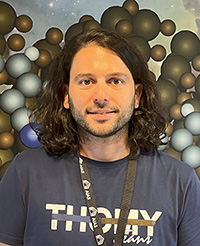
I am an AIAS Fellow at the Aarhus Institute of Advanced Studies (AIAS). I obtained my PhD in Astronomy at Leiden Observatory in the Netherlands, where I used density functional theory (DFT) to study the role of polycyclic aromatic hydrocarbons (PAHs) as potential catalysts for H₂ formation in star-forming regions, as well as their interaction with olivine under planetary system conditions to explore their possible role as precursors to life.
Following my PhD, I held a postdoctoral appointment at the University of Chicago, where I further developed my theoretical skills in materials science applications. I was then awarded a Humboldt research fellowship at the University of Stuttgart in Germany, where I continued my research on the interaction of PAHs with olivine surfaces and the hydrogenation of PAHs. During this time, I employed machine learning techniques to investigate dust atomistic reconstruction and to study how PAHs bind to damaged dust surfaces, thereby slowing their destruction by the actions of shocks and cosmic rays. I also explored deep quantum tunneling mechanisms to elucidate the hydrogenation pathways of PAHs under very low-temperature conditions.
After these experiences, I worked as a postdoctoral researcher at the University of Perugia, where I investigated the interaction of oxygen atoms with hydrocarbons in low-Mars-like atmospheres, as well as the formation of the first seed particles involved in circumstellar dust formation processes.
Currently, as an AIAS Fellow, I will work on a project that combines novel machine learning techniques developed at Aarhus University to study the formation of the first RNA monomers from PAHs, aiming to test and clarify the “PAH world hypothesis” for the origin of life.
dario.campisi@aias.au.dk
1520-337 Ny Munkegade 120
DK-8000 Aarhus C
Origin of Life
I apply density functional theory (DFT) combined with surrogate machine learning methods — specifically global optimization techniques using first-principles energy expressions—to study the addition of nitrogen radicals to PAHs at the olivine–water ice interface in interstellar dust. The goal of this work is to understand the formation of adenine, a key nitrogenous base and a precursor of the first RNA monomers.
I am also interested in how hydrogenation and oxygenation processes of hydrocarbons might lead to the formation of fatty acids under cold interstellar medium conditions, providing insight into possible prebiotic chemistry pathways that could contribute to the emergence of life.

Dust Formation and Preservation
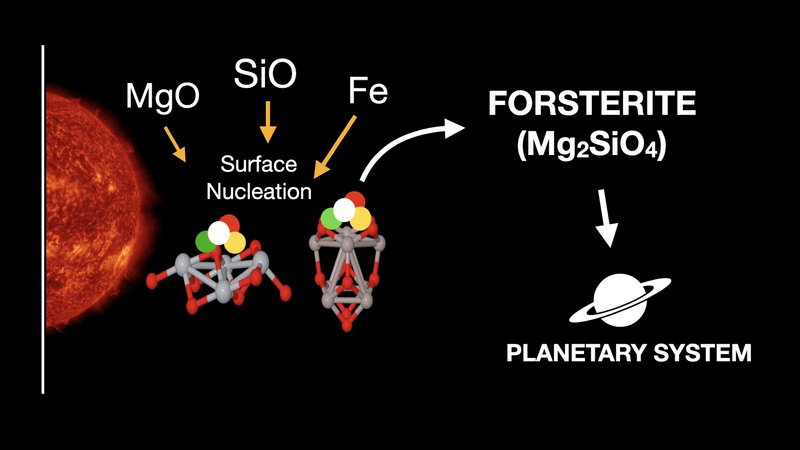
I use density functional theory (DFT), surrogate machine learning methods, and post–Hartree–Fock approaches—such as Coupled Cluster (CC) and n-electron valence state perturbation theory (NEVPT2)—to study the formation of the first seed particles that may have initiated cosmic dust formation in circumstellar environments. My research focuses on understanding how pre-existing surfaces may have promoted the formation and nucleation of forsterite (Mg₂SiO₄), one of the most abundant silicate minerals in space. I have also worked on atomistic reconstructions and investigated the role of PAHs in protecting dust from the destructive effects of shocks and cosmic rays, employing surrogate machine learning-based global optimization methodologies.
[1] D. Campisi, A.G.G.M. Tielens, W. Dononelli, MNRAS, 533 (2024) 2282-2293. doi.org 10.1093/mnras/stae1962
[2] Rosi, M., Campisi, D., Di Genova, G., Gervasi, O., Ceccarelli, C., Balucani, N. (2026). Formation Routes of Interstellar Metal Oxides: A Computational Chemistry Approach. In: Gervasi, O., et al. Computational Science and Its Applications – ICCSA 2025 Workshops. ICCSA 2025.
Lecture Notes in Computer Science, vol 15888. Springer, Cham. doi.org 10.1007/978-3-031-97596-7_19
Hydrogenation of PAHs
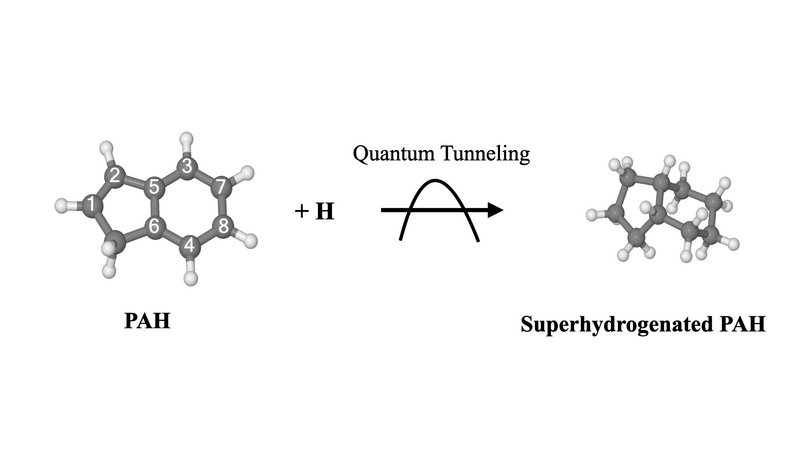
I use DFT to study the processes that lead to PAH superhydrogenation under photodissociation region (PDR) and dark molecular cloud conditions. In these environments, quantum tunneling of hydrogen atoms can explain the superhydrogenation process that drives H₂ formation as well as PAH fragmentation. This research helps us understand how PAHs act not only as catalysts for the formation of the most important molecule in star-forming regions (H₂) but also as carbon reservoirs in the interstellar medium.
[3] S. Haid, K. Gugeler, J. Kästner and D. Campisi, A&A, 701 (2025) A34. doi.org 10.1051/0004-6361/202451572
Oxygenation of PAHs
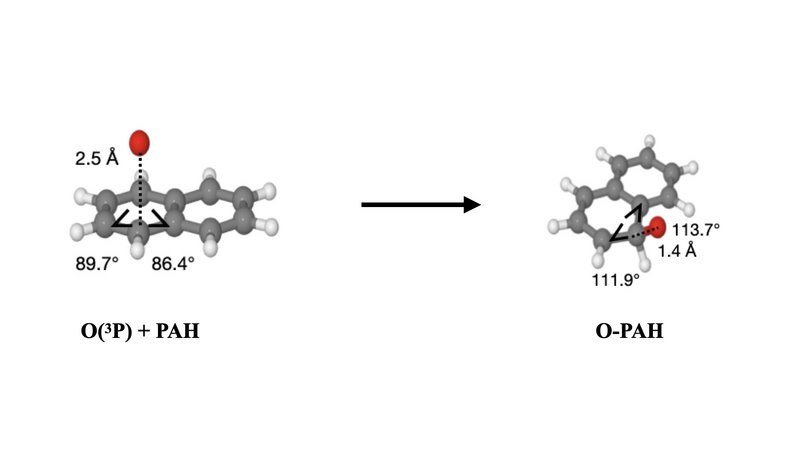
I investigate, using DFT, CCSD(T), and NEVPT2, the processes leading to oxygen attachment on PAHs. Oxygen is the third most abundant element in the universe. It interacts with PAHs by fragmenting them, forming mainly CO and other carbonaceous products. I specifically study fragmentation pathways on the adiabatic potential energy surface, as well as subsequent intersystem crossing (ISC) processes, to understand PAH fragmentation in low-Mars-like atmospheres and the interstellar medium.
[4] Campisi, D., Pannacci, G., Balucani, N., Rosi, M. (2026). Modeling Polymer Degradation by Atomic Oxygen in Low Mars and Earth Orbits: Are Diffuse Functions Necessary?. In: Gervasi, O., et al. Computational Science and Its Applications – ICCSA 2025 Workshops. ICCSA 2025. Lecture Notes in Computer Science, vol 15888. Springer, Cham. doi.org 10.1007/978-3-031-97596-7_18 + H PAH Superhydrogenated PAH O Quantum Tunneling