
Release of first results from the ALMA Large Program COMPASS - Jes Jørgensen
The first results from the ALMA Large Program COMPASS offer new clues to the origins of chemical complexity during star and planet formation.
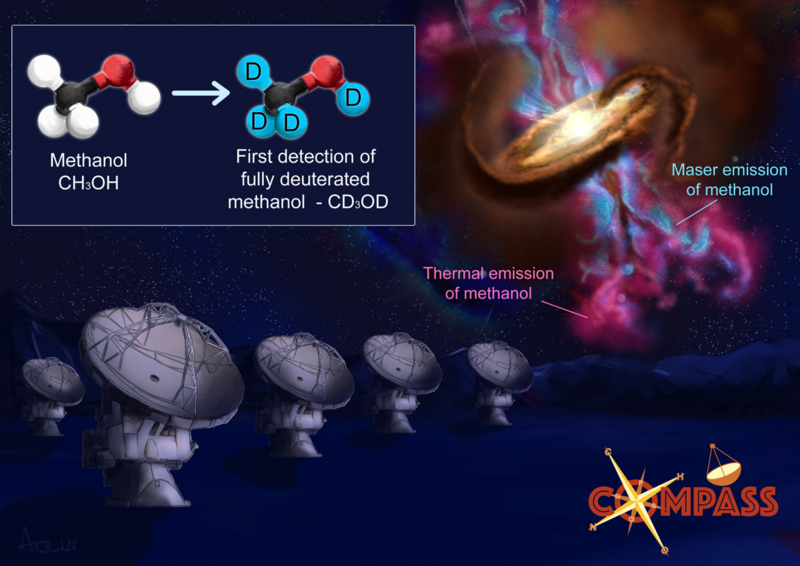
The first results from the ALMA Large Program COMPASS were just released. COMPASS (Complex Organic Molecules in Protostars with ALMA Spectral Surveys) is led by Jes Jørgensen from the Niels Bohr Institute at University of Copenhagen, who joined InterCat at the start of its second funding period. Through COMPASS, Jes’ group and the international team behind the program are studying the chemistry of warm gas around young Sun-like stars on scales where future planetary systems are formed. Using the extraordinary sensitivity and angular resolution of ALMA (the Atacama Large Millimeter/submillimeter Array) the project surveys a sample of protostars in unprecedented detail, revealing the chemical complexity during the earliest stages of star and planet formation.
The goal of COMPASS is to understand how organic molecules emerge around these young systems and how their abundances depend on both the natal cloud environment and the evolutionary stage of the protostar. Among the first results is the first detection in interstellar space of fully deuterated methanol, CD3OD, a form of methanol in which all hydrogen atoms have been replaced by deuterium. The abundance of this molecule is surprisingly high, pointing to its formation under very cold conditions in the material surrounding the young protostars, while also posing a challenge to current astrochemical models. Another highlight is the discovery of methanol masers towards several of the COMPASS sources, a phenomenon that was previously thought to be associated primarily with regions of high-mass star formation.
One focus of the InterCat activities in Copenhagen over the coming years will be to harvest the wealth of information contained in the COMPASS dataset and combine it with observations of ice chemistry in the same regions from ongoing programs using the James Webb Space Telescope. Together, these observations will provide an empirical view of the gas and ice chemistry that combined with the theoretical modeling and laboratory experiments carried out across InterCat will help build a more complete picture of the origin of chemical complexity during star and planet formation.
For more about COMPASS see the press release at https://public.nrao.edu/news/cosmic-cocktail-alma-compass/