
New InterCat paper - Lars Borchert, David Field and Andrew Cassidy
Title: Spontaneously polarised crystalline water ice
Authors: Rachel L. James, Frank P. Pijpers, Lars Borchert, David Field and Andrew Cassidy
Journal: Nanoscale
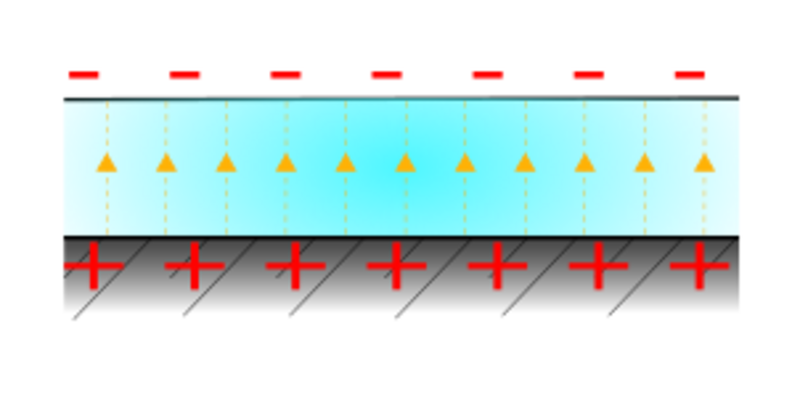
Thin films of water ice, just tens of nanometers thick, were grown at the AUUV ices end station, at the AUUV beamline attached to the ASTRID2 synchrotron in the basement at the Department of Physics and Astronomy, at Aarhus University. This allowed us to make precise measurements of how the VUV absorption spectrum of water ice changes as a function of the thickness of the ice and also, crucially, the temperature of the surface on which the ice is grown. As the temperature of the substrate changes, the peak position in the VUV absorption spectrum also changes. For amorphous water, prepared between 20 K and 125 K, these peak shifts with temperature move in the opposite direction to peak shifts with temperature for cyrstalline water, grown between 127 K and 140 K. These effects are very subtle but the conclusions are profound and demonstrate that water ice films prepared in this way spontaneously harbour electric fields.
That amorphous water ice films harbour electric fields was known and the obseravations reported here match well with those in the literature. But observations of electric fields in thin films of crystalline water, is reported here for the first time and demonstrates that, at least in thin films, crystalline water ice can spontaneously break symmetery to become polarised.
These experiments were done in collaboration with Rachel L. James (The University of Manchester) and the analysis was done in collaboration with Frank P. Pijpers (University of Amsterdam).