
Yuan Chen completes her PhD
On February 24, Yuan Chen successfully defended her PhD thesis entitled
"A song of gas and ice: the formation and evolution of complex organic
molecules" at Leiden University.
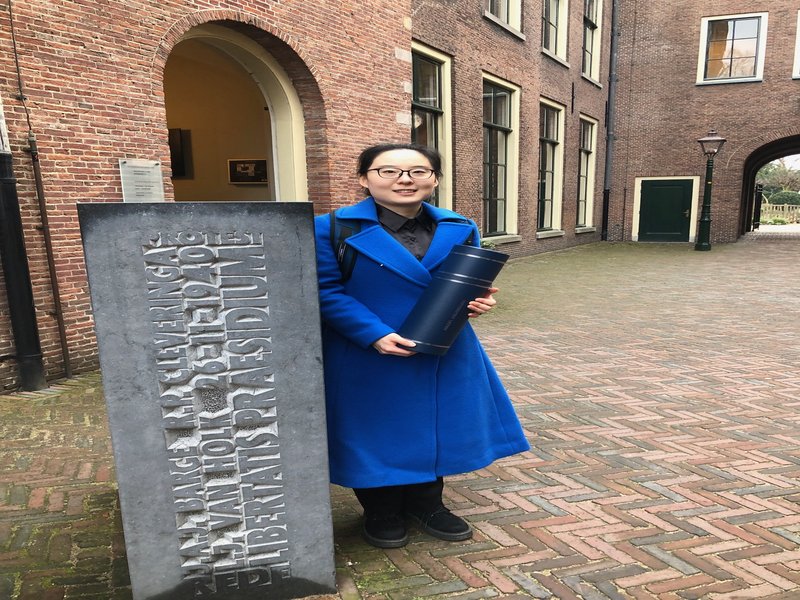
Yuan started her InterCat PhD position in Leiden in fall 2021 under the supervision of Ewine van Dishoeck and Harold Linnartz. The goal was clear from the beginning: the James Webb Space Telescope (JWST) was about to be launched and was going to revolutionize studies of interstellar ices, including searches for more complex molecules in regions where new stars and planets are born. These so-called COMs had so far only been observed in the gas but their formation route was unclear.
While waiting for JWST to be launched and commissioned, Yuan first carried out a quantitative study of oxygen-bearing COMs using the Atacama Large Millimeter Array (ALMA) in a set of high-mass protostars. Surprisingly, their abundance ratios do not vary between sources in spite of different luminosities. There does appear to be some chemical selectivity: the three-carbon molecules acetone and propenal are found to be more abundant than two-carbon aldehydes.
Subsequently, Yuan's focus shifted from gas to ice. She demonstrated, together with other Leiden ice experts, the detection of solid-phase COMs larger than methanol with JWST. This required access to many laboratory ice spectra collected in the Leiden Ice Database. She also presented the first direct gas-to-ice comparison of COMs in the same protostellar systems by linking JWST with ALMA data. The results indicate that both inheritance from ice formation and subsequent gas-phase reprocessing can play significant roles in shaping the COM chemistry. Altogether, Yuan has played a crucial role within InterCat in linking astronomical observations with laboratory data and theoretical models.
Yuan has been remarkably successful in getting observing time on major astronomical telescopes like JWST and ALMA in spite of huge oversubscriptions. Analyzing them will be part of her postdoc position
at the Max Planck Institute for Extraterrestrial Physics in Garching, Germany. Yuan likes good (Chinese) food and has found - to her big relief - a much better canteen at Max Planck than in Leiden.
Congratulations to Yuan on opening up novel scientific avenues: we wish her all the best with her future research.