IRAstro – Molecular Quantum Dynamics in Low Temperature Condensed Phase Astrochemistry
The ERC Synergy project IRAstro brings together leading researchers in physics, chemistry, and astrochemistry to uncover how molecules behave and react under the extreme conditions of interstellar space.
Recent observations from the James Webb Space Telescope (JWST) reveal the complexity of low temperature molecular ices frozen out on interstellar dust grains in regions where new stars and planetary systems are formed. Interpreting these observations requires a deeper understanding of the fundamental physical and chemical processes that govern molecular behaviour at temperatures close to absolute zero.
IRAstro addresses this challenge by combining cutting-edge laboratory experiments, advanced instrumentation, and first-principles theory. The project focuses on the quantum dynamics of molecules in low-temperature condensed phases - a frontier area essential for understanding how chemical complexity arises in space.
Towards a new understanding of Low Temperature Condensed Phase Astrochemistry
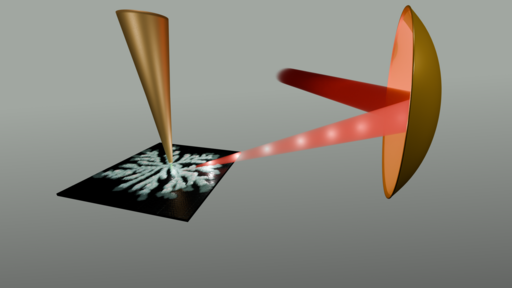
By bridging experiment and theory at unprecedented resolution—including single-molecule infrared spectroscopy—IRAstro aims to expand our understanding of chemistry in space.
The project will:
IRAstro is structured around three synergistic research themes:
1. Infrared spectra under interstellar conditions
Understanding how molecular spectra are shaped by their environment, enabling interpretation of JWST data.
2. Energy dissipation on cold surfaces
Revealing how excited molecules release energy in icy interstellar environments.
3. Chemical reactivity in space
Identifying reaction mechanisms, including quantum tunnelling and pathways toward complex organic molecules.
The project seeks to answer fundamental questions in astrochemistry:
