
Complex systems with hidden simplicity
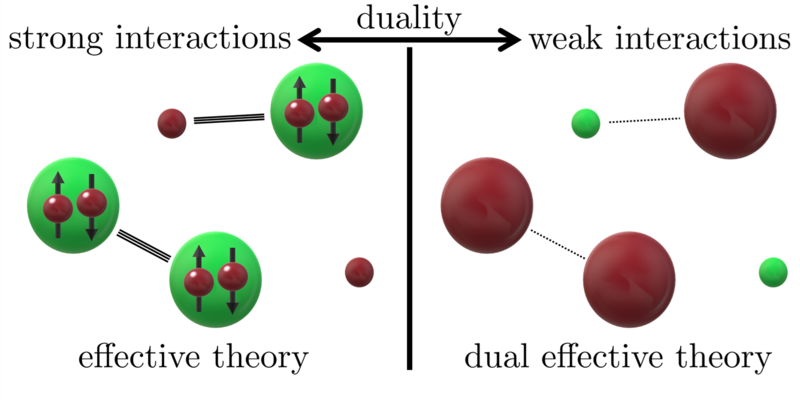
Many-body quantum systems with strong interactions are notoriously challenging to solve. However, in rare cases, such systems can behave as if they are effectively weakly interacting—though this is not apparent at first glance. Researchers from TU Darmstadt (Germany), Massey University (New Zealand), and Aarhus University (Denmark) have demonstrated that spin-1/2 particles with strongly attractive interactions confined to one dimension fall into this exceptional category.
To uncover this, they developed an effective theory that captures the essential physics of the system and showed that it can be mapped onto a weakly interacting model. This breakthrough enables analytical studies of confined many-fermion systems that are otherwise inaccessible using conventional methods. Moreover, it offers a valuable benchmark for the development of new numerical techniques aimed at tackling other complex many-body quantum systems.
Read the full article here: https://doi.org/10.1103/8mnc-x42q