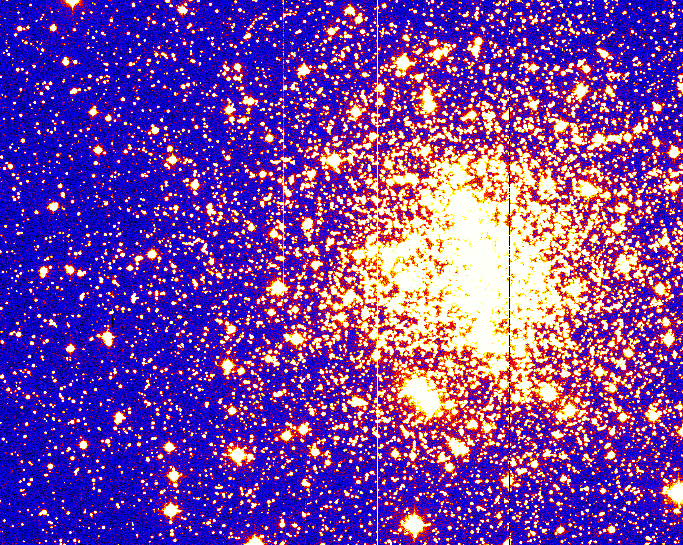
Part of a CCD image of the Globular Cluster M4
This is the equivalent of photoelectric photometry using one or more apertures to define the area of sky, where the measurement is derived. In CCD photometry one has the option to tune parameters according to the problem as the reduction takes place on a computer.
The technique must be able to deal with different conditions: high or low sky background, readout noise, crowding problems etc.
The technique works well, in fact better than other methods, for bright isolated stars under stable atmospheric conditions.
Here one fits a function, the Point Spread Function, to single, bright, isolated stars. It is important to choose a properly defined function. It can be an analytical function or a table. Or it can be a mix of both.
At some telescopes you will find, that this function varies over the field of view, and it is necessary to have a PSF, which varies with position. This is the case for the Danish 1.5m telescope at La Silla.
In order to improve noise statistics one can apply weights to the fit of the PSF to the individual stars. For each star one determines the amplitude and the position required to make the best fit of the PSF to each stellar image.
In crowded areas one can apply multistellar fits. The field can be dived in small areas, which contain a small number of stars, which are then fitted with a set of PSF's in an optimal way (LSM?).