
Here I present a range of telescopes used to give imaging outside the optical range. The examples include the areas on both sides of the optical range
One of the most powerful X-ray satellites launched is the Chandra Observatory. The optics consist of a set of 8 mirrors like outlined in Bradt:
The image is recorded by a High Resolution Camera with a resolution of half an arcsecond.
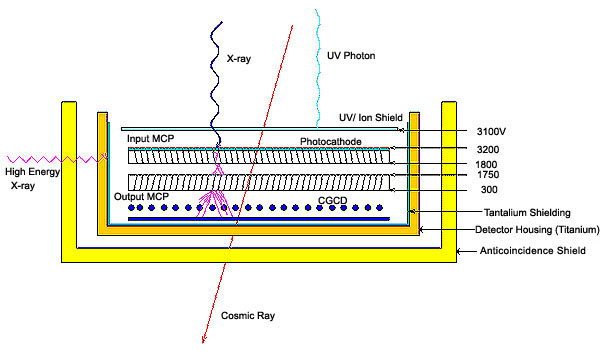
The detector consists of two microchannel plates and finally what us called a Crossed Grid Charge Detector. The CGCD consists of two sets of 64 crossed wires. The CGCD has 100 micron wires on 200 micron centers and provide a resolution of 6.4 micron in position. The combined MCPs and the CGCD accuracy is 20 micron corresponding to 0.5 arcs.
As an example of an X-ray image you can take a look at the galaxy NGC 5128, an active galaxy with a black hole in the center.
The Compton Gamma Ray Observatory has an imaging instrument, which is among the best flown so far. The 'telescope' is shown in this figure:
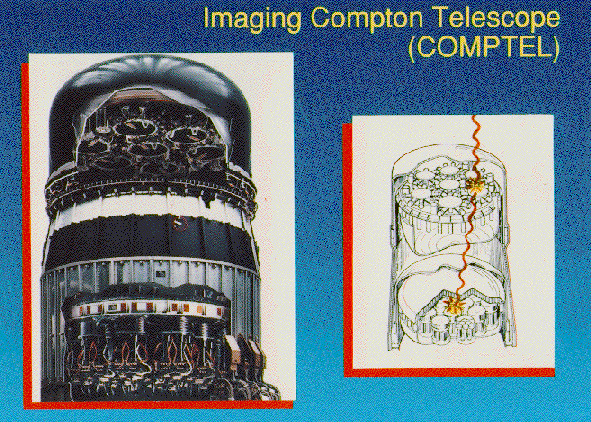
By recording the time and position of thw two events a resolution between 1.7-4 degrees is obtained. The energy resolution is 5-8% in the range 0.8-30 MeV.
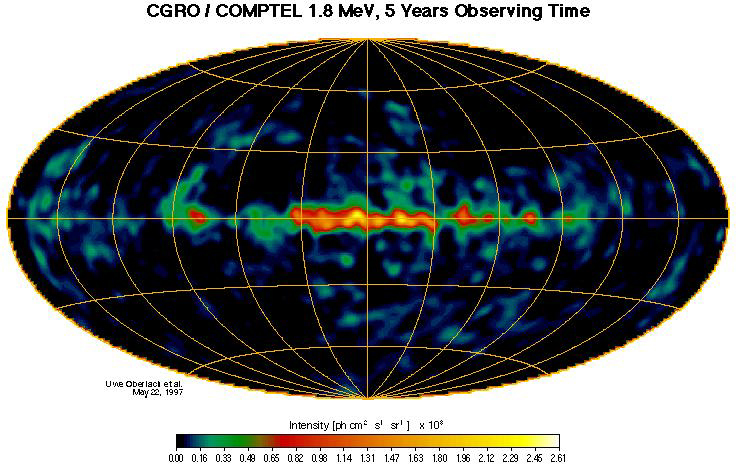
An all sky image obtained with COMPTEL is shown here:
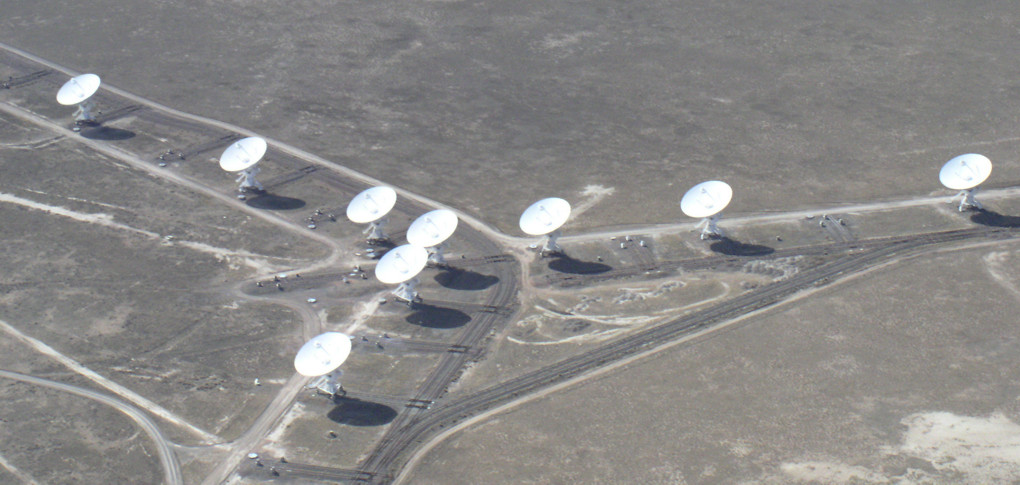
Using interferometry one can do imaging in the radio regime. One of the most productive telescopes of this type is the Very Large Array in the desert of New Mexico. This telescope reaches a resolution as low as 0.04 arcs. It operates between 0.7 to 400 cm in wavelength ad achieves it highest resolution at the short wavelength end. At 400 cm the resolution is only 20 arcs. The 'telescope' is a set of 27 antennas placed in an Y shape as seen on this figure:
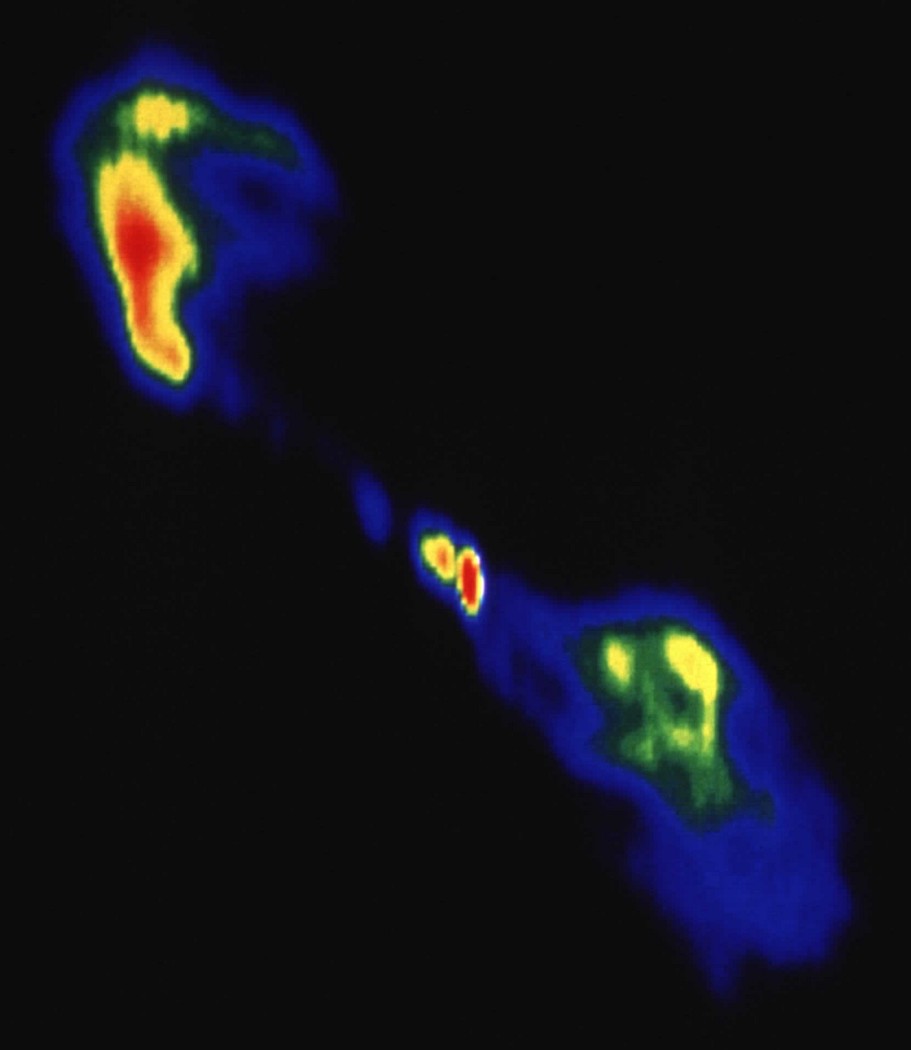
As an illustration of an radio image, the galaxy presented in X-rays NGC 5128 is here shown at radio wavelength 20 cm as published by NRAO. The field is much bigger than the X-ray image.
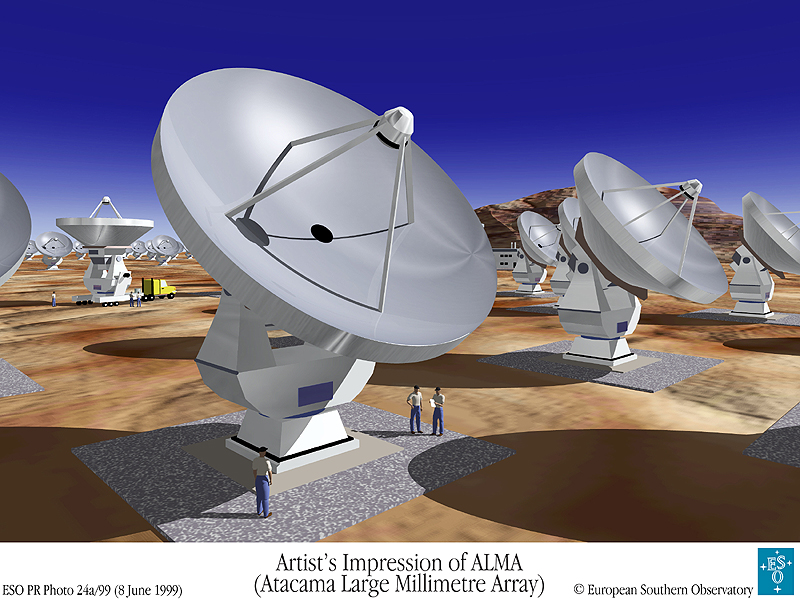
As the last example the new, not yet existing, telescope called ALMA being built in Chile by ESO and US institutes represented by NSF in Chile is presented. ALMA stands for the Atacama Large Millimeter Array. It will consist of 64 12m antennas. The frequencies to be used range from 86 to 720 Ghz. The shortest wavelength is therefore 0.4 mm orr 400 micron. The surface of the mirrors are machined to an accuracy of 20 micron over the 12 m of diameter! The spatial resolution depends, as for the VLA, on the frequency used. For the largest baseline it is 0.012"(350/freq) or less than 0.01". This is a factor of 10 above what can be achieved in the optical domain.
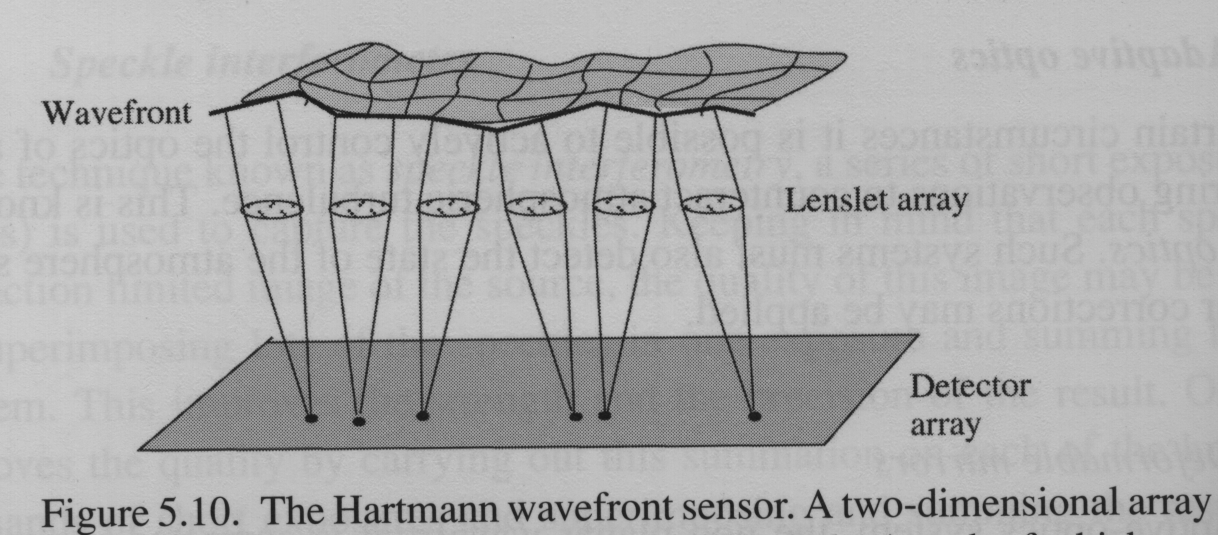
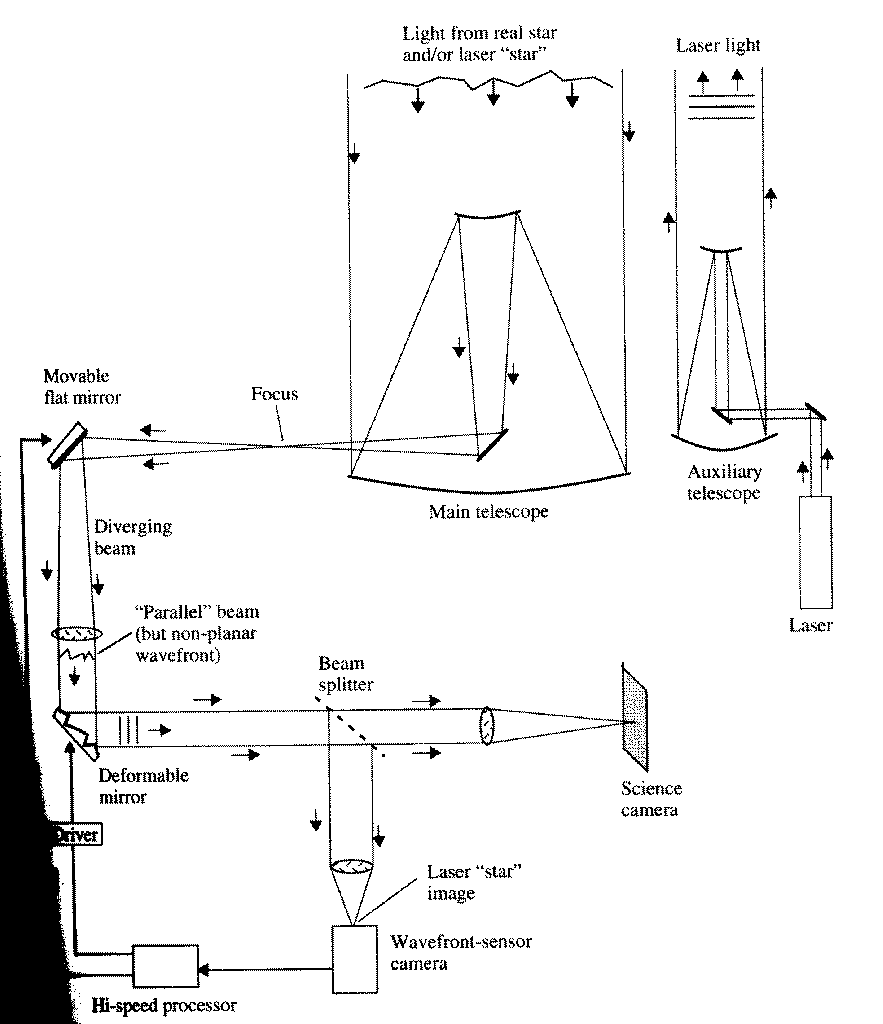
The following image was obtained of the center of the Milky way with the VLT and the NACO instrument, where one sees a number of stars that orbit the massive black hole of 3 million solar masses located at the position of the radio source Sgr A.
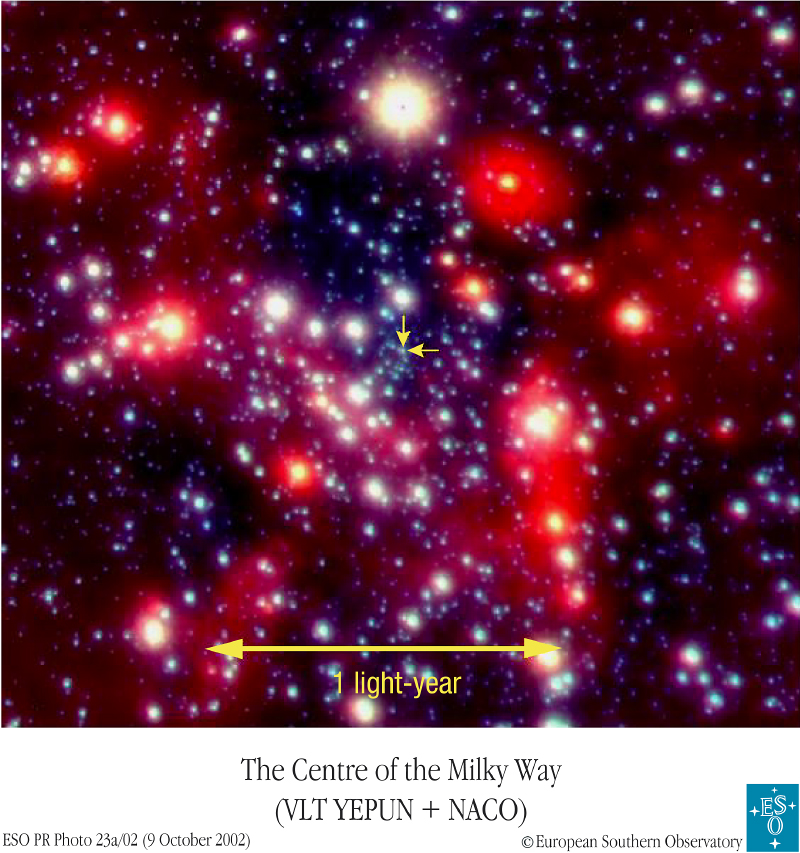
This is an image from an ESO press release from 2002.
You can see more details about the very centre in the press
release. See also a later
press release, which gives evidence of the violent activity close
to the black hole of 2.5 million solar masses.
Finally you can take a look on a web page
published by the TMT project, which also includes an interesting movie
of the movement of the stars around the Galactic Center.