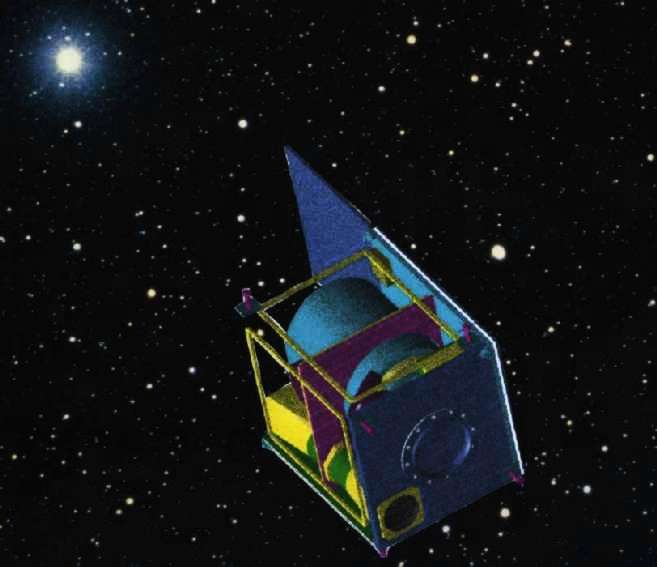
To provide new insights into the structure and evolution of stars, using them as laboratories to understand physics under extreme conditions, by studying oscillations in a sample of 20 solar-type stars.
For information about the study of oscillations in the sun (helioseismology) and in stars (asteroseismology), click here.
To study the structure and evolution of stars hotter and more massive than the Sun (delta Scuti and rapidly oscillating Ap stars) by measuring their oscillations
To study variability in a large sample of stars of all types
MONS will measure oscillations in about 25 nearby stars by monitoring the brightness and colour fluctuations in each star for about one month.
Spacecraft: Overall dimensions 600 X 600 X 800 mm; mass 65 kg; power budget 60 W.
Orbit: Elliptical with a high apogee, to allow (i) almost continuous observations of each star, and (ii) access to the whole sky during the course of a year. The baseline is a Molniya orbit, with a high inclination that will minimise radiation exposure, with a mission lifetime of two years.
Attitude control system: MONS will be 3-axis stabilized, with a required precision of about 0.02 degree rms (1.2 arcmin). This will be achieved using momentum wheels, with attitude sensing via two wide-field star imagers. The star imagers will also serve as secondary scientific instruments, providing photometry for about 10000 stars over the mission.
Telescope and optics: The telescope is a 34-cm reflector, with a dichroic beamsplitter to form side-by-side blue and red stellar images. Each stellar image is highly defocussed to avoid saturating the CCD detector and minimize sensitivity to attitude movements.
Data handling system: Data frames will be taken every 4 seconds and on-board data processing will measure the brightness of the star every 20 seconds. The down-link rate, including house keeping, will be below 4 Mbyte per day.
Click here for more pictures of MONS.
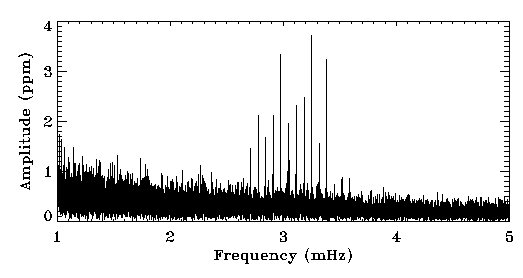
Simulation showing the amplitude spectrum that would be obtained by MONS from observing colour fluctuations in a solar-type star with magnitude V=2 for 30 days. The regular series of peaks are p-mode oscillations, and their frequencies would give a tremendous amount of information about the internal structure of the star. The background noise, increasing towards lower frequencies, is mostly due to stellar granulation.